WHO Consultant on Health Systems Resilience & Essential Public Health Functions Visits WFCMS
Release time: Mar 4,2026
Reading volume: 4589
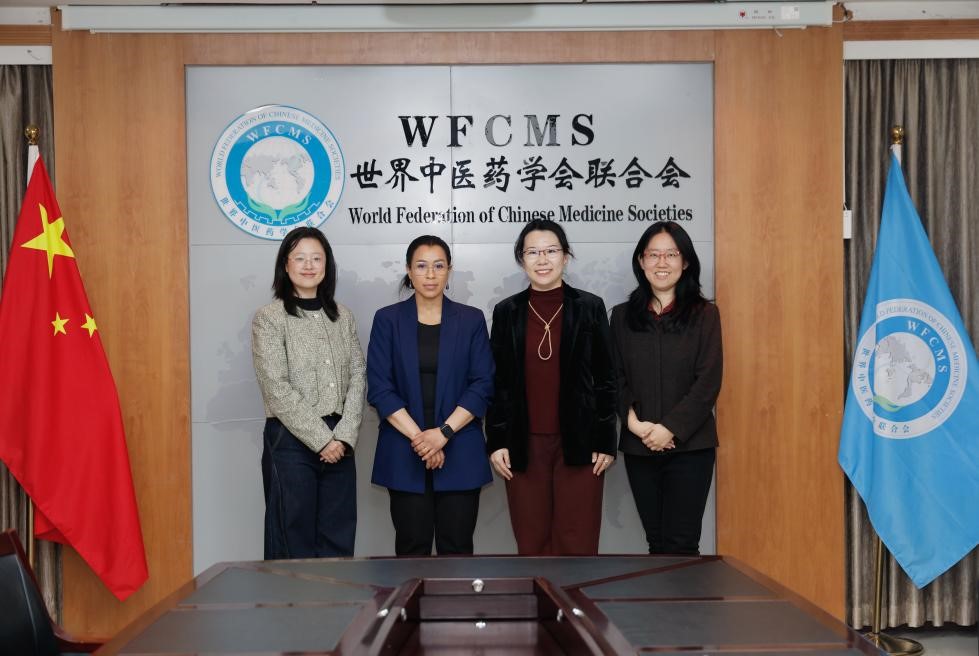
On the afternoon of March 2, Ms. Redda Seifeldin, Consultant for Health Systems Resilience and Essential Public Health Functions at the World Health Organization (WHO) Headquarters, visited the World Federation of Chinese Medicine Societies (WFCMS). She held a meeting with Dr. Wang Jing, Assistant to the Secretary-General of WFCMS, for in-depth discussions on strengthening health systems resilience and integrating Traditional Chinese Medicine (TCM) into public health systems.
Ms. Seifeldin introduced the WHO project on strengthening health system resilience and essential public health functions and services including integration of Chinese medicine. She expressed the hope that China's experience in integrating Chinese and Western medicine could serve as a valuable reference for global and national-level policy development and practice.
Dr. Wang Jing noted that the strong policy execution capacity of the Chinese government is key to effectively implementing TCM services at the grassroots level, which must be adapted to the specific national contexts of other countries. She highlighted the significant role TCM played during the COVID-19 pandemic, demonstrating its value within the public health system.
The meeting reached a consensus on future collaboration. WFCMS pledged full support throughout the implementation phases of the WHO project, aiming to jointly promote global health systems resilience and contribute to the achievement of Universal Health Coverage and the Sustainable Development Goals.
Mr. Zhang Yu from WHO participated online, and representatives from the WFCMS International Liaison Department were also present.
Ms. Seifeldin introduced the WHO project on strengthening health system resilience and essential public health functions and services including integration of Chinese medicine. She expressed the hope that China's experience in integrating Chinese and Western medicine could serve as a valuable reference for global and national-level policy development and practice.
Dr. Wang Jing noted that the strong policy execution capacity of the Chinese government is key to effectively implementing TCM services at the grassroots level, which must be adapted to the specific national contexts of other countries. She highlighted the significant role TCM played during the COVID-19 pandemic, demonstrating its value within the public health system.
The meeting reached a consensus on future collaboration. WFCMS pledged full support throughout the implementation phases of the WHO project, aiming to jointly promote global health systems resilience and contribute to the achievement of Universal Health Coverage and the Sustainable Development Goals.
Mr. Zhang Yu from WHO participated online, and representatives from the WFCMS International Liaison Department were also present.